
Last updated October 30, 2026
 Home additions & ADU
 Kitchen remodeling
 Bathroom remodeling
 Roofing
 Windows & doors
 Driveway & pavers
 Fence
Free written scope consultation - allowances, timeline, and change-order rules on paper before a single trade is scheduled
Construction Warning Signs: A Hesperia Homeowner’s Reference Guide
A hairline stucco crack that would be cosmetic in San Diego can signal active foundation movement in Hesperia, where expansive clay soils shift seasonally with every wet-dry cycle. The crack pattern tells the story if you know the difference between a diagonal shear crack and a thermal shrinkage crack. Most homeowner guides are written for wet climates and miss what desert conditions actually do to a house, which is why we publish more guides & resources tailored to high-desert homeowners. This guide teaches you to read the desert-specific signals Hesperia homes send before minor movement becomes a five-figure structural repair, covering everything from stucco stress patterns to roofing granule loss, door alignment drift, and the flatwork heave that points to subsurface drainage failure.
Quick Answer
The most reliable construction warning signs in Hesperia are diagonal stucco cracks wider than 1/8 inch, doors that bind or fail to latch seasonally, roof shingles losing granules faster than a comparable neighbor’s roof, and concrete flatwork that heaves unevenly after rain. In Hesperia’s expansive clay soil, these symptoms typically indicate moisture-driven soil movement rather than simple material aging, which means drainage correction matters as much as the visible repair—a topic we cover in depth in our General Contractor Maintenance Checklist for Hesperia Homeowners.
Styles & brands we work with
Table of Contents
- Reading Stucco Cracks: Cosmetic vs. Structural in Hesperia’s Clay Soil
- Desert Roofing Failures: Granule Loss, Brittleness, and What to Check Before Rain
- Interior Warning Signs That Point to Exterior Envelope Failure
- Flatwork, Driveways, and Patios: Reading Heave Patterns in the High Desert
- How to Photograph and Document Warning Signs Over Time
- Hesperia Soil Behavior and the Drainage Connection
- Common Mistakes to Avoid
- When to Call a Professional
Reading Stucco Cracks: Cosmetic vs. Structural in Hesperia’s Clay Soil
Stucco is the dominant exterior finish throughout Hesperia, and it cracks for two very different reasons. The first is thermal shrinkage: as stucco cures and ages, it contracts slightly, producing hairline cracks that run in straight lines and stop at control joints or corners. These are typically under 1/16 inch wide, remain stable for years, and are not structural. The second is structural movement: as expansive clay soil beneath the foundation swells with winter moisture and shrinks through summer drought, the foundation flexes enough to transfer stress through the stucco in distinctive diagonal patterns. In our experience walking Hesperia homes, the difference is usually visible within thirty seconds of looking at the right spot.
Here is how you tell them apart:
- Thermal shrinkage cracks are hairline (under 1/16 inch), straight or slightly wavy, vertical or horizontal, and tend to appear symmetrically around windows and door corners. They do not widen over time and do not extend through wall-to-wall intersections.
- Diagonal shear cracks start at a corner of a door or window and angle downward or outward at 30 to 60 degrees. If the crack is wider at one end than the other, that is movement, not shrinkage. Widths over 1/8 inch anywhere along the run suggest active soil pressure or settlement.
- Stair-step cracks in stucco over block or brick veneer follow the mortar joints in a staircase pattern. In Hesperia, this pattern almost always traces back to differential soil movement under one section of the foundation, not to the stucco itself.
- Horizontal cracks at mid-wall height, especially on retaining walls or walkout basements, indicate lateral soil pressure. This is serious and should be evaluated promptly.
What makes Hesperia different from coastal Southern California is the soil. Much of the Victor Valley sits on expansive clay that can change volume by 10% or more between dry and saturated states. A wet winter like 2023’s swells the clay along the foundation perimeter unevenly, lifting one corner while the rest of the slab stays put. The stucco cracks that appear by spring are the house literally telling you where the soil pressure is concentrated. Photograph them, mark the date, and check again at the end of summer. If the crack closes in late summer and reopens after rain, the cause is moisture-driven soil movement, not a failing foundation wall. That distinction determines whether the fix is structural or drainage-related, and it saves Hesperia homeowners thousands of dollars that a less soil-aware contractor might spend on unnecessary pier work.
Desert Roofing Failures: Granule Loss, Brittleness, and What to Check Before Rain
In wetter climates, roof failure announces itself with a ceiling stain or a drip. In Hesperia, where an average year delivers only a handful of significant rain events, the same roof can fail quietly through granule loss and asphalt brittleness, then pour water into the attic during the first heavy storm. The roof has been telling you for two years; the desert just muffled the message. The single most useful thing a Hesperia homeowner can do is inspect the roof between rain events, not during one.
Composite asphalt shingles rely on embedded granules to block ultraviolet radiation and protect the asphalt substrate. High-desert sun at 3,200 feet elevation works on those granules relentlessly. The first visible sign is not a leak. It is granule loss: a balcony gutter showing a fine black or gray grit, a downspout splash block with a drift of granules after a dry wind, or patchy, lighter-colored spots on the shingle surface where the asphalt is beginning to show through. Run your hand (gloved, if you are up there) across a suspect shingle. If granules come off like sand, the shingle is near the end of its functional life, even if it has never leaked a drop.
The second desert-specific signal is brittleness. Shingles that curl at the edges, crack when bent slightly, or show surface crazing have lost their flexibility. In Hesperia’s temperature swings, where a July afternoon can hit 105°F and a winter night can drop below freezing, brittle shingles crack and separate. Once the shingle is cracked, water entry is just waiting for the right storm intensity. Look specifically at south- and west-facing roof planes, which absorb the strongest sun and age faster than north-facing slopes. A roof where the south face is bald and cracked while the north face still looks serviceable is a classic Hesperia pattern, and it tells you the roof is failing directionally, not uniformly.
Also check flashing at penetrations: skylights, plumbing vents, furnace flues. Desert UV breaks down the sealant at flashing joints faster than in coastal climates. Look for cracked caulking, lifted flashing edges, or rust staining on galvanized boot flashings. None of these produce a leak on a dry day, but each one is an open entry point when rain does come. If you are working with a contractor on a broader exterior project, this is where the roof inspection should start. We carry GAF, CertainTeed, and Owens Corning roofing systems because the high-desert UV load demands materials with documented granule retention and flexibility ratings, and because manufacturer specs matter more here than they do two hours west.
Interior Warning Signs That Point to Exterior Envelope Failure
Some of the earliest construction warning signs in Hesperia show up inside the house, in rooms where nothing is wet and nothing looks broken. Desert conditions delay the visible moisture indicators that other climates rely on: no mold on the baseboards, no efflorescence on the drywall, no musty smell in the closet. Instead, the interior telegraphs envelope failure through mechanical movement, subtle air pressure changes, and condensation behavior. Learning to read these interior signals is the highest-leverage diagnostic skill a Hesperia homeowner can develop, because they often appear twelve to eighteen months before exterior damage becomes undeniable.
Door alignment drift is the most commonly reported early signal. A door that latched perfectly for five years starts sticking at the top corner in summer, or the deadbolt no longer lines up with the strike plate by a quarter inch. Seasonal sticking is normal in clay-soil country, but a progressive drift that worsens with each season is not. Mark the misfit with a pencil line, date it, and re-check in the opposite season. If the path of the door changes by more than 1/8 inch over a single wet-dry cycle, the foundation is moving enough to affect the frame. In Hesperia neighborhoods built on old Mojave River floodplain deposits, like parts of the Mesa and areas east of the I-15, this pattern is common enough that we consider door drift a first-tier structural signal rather than a nuisance.
Window condensation behavior is another desert-specific diagnostic. A double-pane window showing condensation between the glass panes has lost its seal, full stop. But Hesperia homeowners should also watch for condensation on the interior glass surface on winter mornings in rooms that never had it before. That pattern suggests warm, humid interior air is reaching the glass because the window’s perimeter seal or weatherstripping has failed, or because the wall cavity has a new air leak. In a properly sealed envelope, interior condensation forms first on single-pane or metal-frame windows, not on good double-pane units. If your best windows are fogging while your old aluminum sliders are dry, the air movement is coming through the wall, not the glass.
Drywall nail pops complete the trio. A few nail pops in a new home’s first two years are normal settling. But a cluster of pops appearing along a single ceiling joist line, or popping that recurs in the same location after you patch it, indicates the framing is flexing. In Hesperia’s climate, that flexing usually traces back to foundation movement or to truss uplift caused by moisture-driven expansion in the attic. The fix starts with a roof and attic ventilation assessment, not with another dab of spackle. When we evaluate homes for whole-home remodeling, these three interior signals, door drift, window condensation shifts, and recurring nail pops, form the baseline of our envelope assessment before we ever discuss finishes. They tell us more about what is happening in the walls than any paint color conversation ever will.
Flatwork, Driveways, and Patios: Reading Heave Patterns in the High Desert
Concrete flatwork in Hesperia moves. That is not a defect; it is the material responding to expansive clay soil, thermal cycling, and whatever drainage mistakes previous owners made. The diagnostic challenge is separating the movement that is normal from the movement that is telling you something about water control. The difference is almost always visible in the pattern.
Thermal expansion movement shows up as regular, evenly spaced cracks at predictable intervals. Concrete expands in the high-desert sun, and without properly placed control joints, it cracks at its own rhythm. These cracks are typically straight, vertical through the slab, similar in width along their run, and they appear across the entire pad in a roughly geometric pattern. They are not pretty, but they rarely signal structural failure.
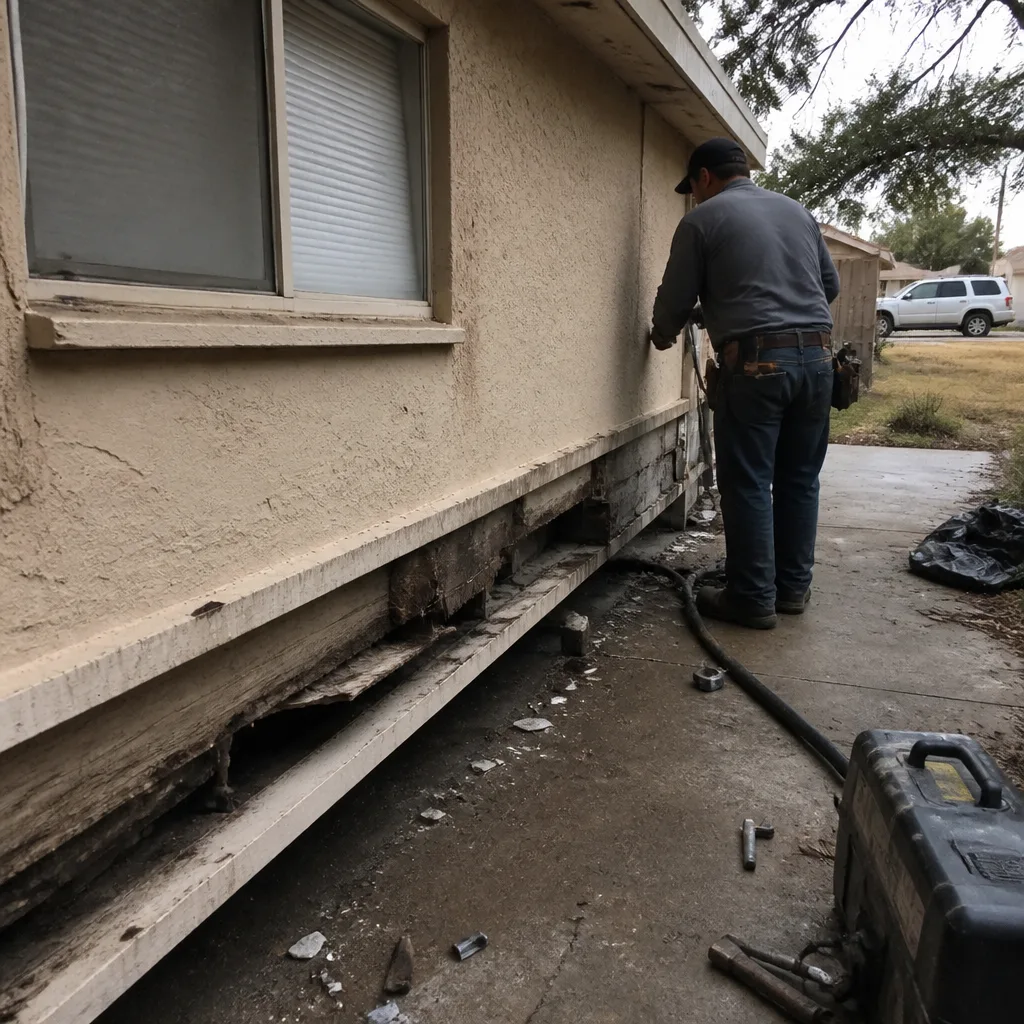
Heave movement looks different. Heaving happens when water enters the soil beneath a slab and swells the clay unevenly. The slab lifts at one edge or in the center, producing differential displacement: one side of a crack is visibly higher than the other, a driveway section tips toward the garage, or a patio slab rises in the middle and pulls away from the foundation at one end. In Hesperia, the most common trigger is landscape irrigation running against the edge of a driveway, roof downspouts discharging at the slab edge instead of a drainage line, or a yard graded toward the house instead of away. Rain that pools against a stoop or walkway for hours after a storm is actively feeding the clay below.
If you see vertical displacement between adjacent slab sections, the issue is water, not aging. Here is a step-by-step triage you can do in one afternoon:
- Walk the driveway perimeter after the next rain and mark every spot where water puddles against the concrete edge.
- Check each downspout. Does it discharge at least six feet from the slab, or does it dump at the slab edge? A downspout dumping at the corner of a patio is a slow-motion heave machine in Hesperia clay.
- Look at the gap between the garage slab and the driveway apron. In many Hesperia homes built in the 1980s and 1990s, the apron tips toward the garage over time, directing surface water back toward the foundation. If the gap is wider at the top than the bottom, the apron has rotated.
- Inspect any hardscape paver areas. Belgard and Unilock pavers are engineered for interlock, but if the base course washes out beneath them, the surface sags or ripples in patterns that follow drainage flow. A paver patio that sinks in a line leading away from a downspout is not a paver defect; it is a base drainage failure.
- Photograph each finding with a reference object (a coin, a level, a piece of chalk) and note the date. This becomes your baseline for the next rain event.
The fix often starts with drainage correction: extending downspouts, regrading planting beds, adding French drains along slab edges. Those corrections are significantly less expensive than slab replacement, and they address the cause rather than the symptom. The mistake we see most often is homeowners patching the concrete without fixing the water, then watching the patch heave again the following spring.
How to Photograph and Document Warning Signs Over Time
A single photo of a crack tells a contractor almost nothing. A series of dated photos showing the same crack over two seasons tells them most of what they need to know before they ever schedule a site visit. Documentation is the cheapest diagnostic tool you own, and most Hesperia homeowners skip it because the process feels tedious. Here is the system we recommend, and it takes less time than you think.
Do not photograph a crack without context. A close-up of a hairline fissure with no scale and no location is diagnostically worthless. Include something for scale: a quarter, a pencil, a tape measure held across the crack. More importantly, pull back and take a second photo showing the crack in relation to the nearest door, window, or corner. A diagonal crack tells a different story than a vertical crack, and the context photo preserves that geometry.
Use a consistent schedule. Desert soil movement follows a seasonal rhythm. Document in October (after the summer dry-down, when cracks are typically widest) and again in March (after winter moisture, when swelling may have closed or widened them depending on the location). Two data points per year, taken at the same wall sections, will reveal whether the movement is progressive or cyclical. Progressive movement is your signal to act; cyclical movement may just require drainage care.
Log the small stuff. A spiral notebook or a notes app works fine. Date, wall location, crack width (measure with a ruler or crack comparator gauge), and current weather conditions. Note whether doors in that section are binding. Note whether irrigation ran that week. Within a year, you will have a dataset that lets a contractor diagnose the mechanism instead of guessing.
Show the series to whoever gives you an estimate. Ten dated photos are worth more than a single visit’s observation, because the contractor cannot see the seasonal cycle in one afternoon. This is the kind of preparation that makes a home estimate conversation productive instead of speculative.
Hesperia Soil Behavior and the Drainage Connection
Everything in this guide traces back to one fact: Hesperia sits on expansive clay soils that respond dramatically to moisture changes. The city straddles the Mojave River watershed, and much of its residential development sits on ancient alluvial deposits: silts and clays laid down when the river carried more water than it does today. When those clays get wet, they swell. When they dry, they shrink. The swelling is uneven, the shrinking is uneven, and the structures above them flex in response.
The practical implication is that drainage is not a landscaping nicety in Hesperia. It is load-bearing infrastructure. The difference between a house that holds up for decades and one that develops progressive foundation movement often comes down to whether roof water and irrigation water are kept away from the soil directly beneath the footings. Homes in Hesperia neighborhoods with older drainage infrastructure, where downspouts discharge at the foundation edge or where the original grading has settled toward the house, show these soil-movement symptoms earlier and more severely than homes with modern drainage systems.
What this means for warning signs: any crack, heave, or door alignment shift you observe should be paired with a drainage question. Where is the water coming from? Where is it going? What changed? Many Hesperia homeowners we talk to describe the start of their problem as the year they changed the front landscaping: new automatic irrigation, a different planting bed configuration, a re-graded turf area. The structure did not change that year; the moisture regime did. The house started speaking in cracks and stuck doors because the soil under one corner had a new water source it had never had before.
This is why a good general contractor in Hesperia evaluates the whole property, not just the cracked wall. The exterior envelope, the roof, the flatwork, and the drainage all operate as one system in clay-soil country. When we take on a home remodeling project in Hesperia, the assessment starts outside, tracing water from the roofline to the street before any interior work is scheduled. That is not scope creep; it is how you avoid remodeling a kitchen that a drainage problem will compromise in five years.
Common Mistakes to Avoid
- Patching cracks without documenting them first. Once you patch a crack, you lose the baseline. A contractor evaluating the home later cannot tell whether the crack was thermal shrinkage or active shear, and you have erased the evidence that would have made the diagnosis quick and accurate.
- Assuming a dry house means a sound roof. In Hesperia’s climate, granule loss and brittleness precede the first leak by months or years. Waiting for water to appear means waiting until the underlayment and decking are already compromised.
- Replacing windows to fix door drift. Doors bind because the frame is moving, not because the door shrank. New windows will not correct a foundation issue, and the drift will continue right past the new installation.
- Adding irrigation against slab edges. Every drop of water placed against a driveway, patio, or foundation edge in Hesperia clay is a small soil-swelling event. Keep irrigation lines at least three feet from flatwork edges, and keep downspout discharge a minimum of six feet from the foundation.
- Sealing stucco cracks from the outside only. If the crack is structural, sealing the exterior face traps moisture and salt behind the patch. Address the movement source first, then repair the stucco.
- Ignoring seasonal patterns. A crack that opens in summer and closes in winter is a drainage signal, not a structural emergency. Misreading the pattern can lead to unnecessary pier work or, worse, ignoring the actual drainage fix that would have solved it.
- Dismissing roof granule loss as normal aging. Some granule loss is normal. A gutter full of granules every season, or bald patches concentrated on one roof face, is not. The UV load in Hesperia is not symmetrical, and neither is the failure it causes.
When to Call a Professional
Some warning signs justify a professional assessment immediately. A diagonal stucco crack wider than 1/8 inch with visible displacement across the crack face, a door that will no longer latch at all, a concrete slab edge that has risen more than a quarter inch against an adjacent section, or granule loss so advanced that the shingle substrate is exposed all warrant a trained evaluation. If multiple signals appear in the same area of the house, a door binding on one side of a hallway while a crack opens in the wall above it, the house is telling you something structural is happening in that zone. Hampton Contractors offers free estimates in Hesperia, call (833) 467-4075 to schedule a walk-through. Bring whatever documentation you have; dated photos and a crack log turn a one-hour assessment into a genuinely diagnostic session.
See the difference
 Before
 After
 Before
 After
 Before
 After
Frequently Asked Questions
A structural crack in Hesperia is typically diagonal, starts at a door or window corner, and is wider than 1/8 inch or wider at one end than the other. Thermal cracks are hairline, straight, and stable. If the crack closes in summer and reopens after rain, soil moisture is the mechanism. Call (833) 467-4075 for a free evaluation if you are unsure.
Granule loss shows up as dark grit in gutters and at downspout bases, patchy lighter spots on shingle surfaces, and a sand-like residue when you rub a shingle face. South- and west-facing slopes lose granules fastest in Hesperia’s sun. A roof check costs less than a ceiling repair.
That seasonal cycle is the signature of expansive clay soil responding to moisture changes. Summer drying shrinks the soil, the foundation shifts slightly, and door frames flex out of square. Winter moisture swells the clay again. Document the pattern; if it worsens yearly, call (833) 467-4075 for an assessment.
No. Concrete heave is usually a drainage problem that has not yet become a foundation problem. Water entering the soil beneath a slab swells the clay and lifts the concrete. Fix the drainage, extend the downspouts, re-grade the surface, and the heaving often stops before structural damage occurs.
An initial professional evaluation may cost the time of a site visit, and many contractors in Hesperia offer free estimates. Hampton Contractors provides free estimates for home renovation and structural assessments. Exact repair costs depend on what the evaluation finds, from simple drainage work to more involved foundation remediation.
Photograph every crack, heave, door misalignment, and roof condition marker at least twice a year, in March and October, with a scale object and a context shot. Include the same wall sections each time. This seasonal series gives a contractor the pattern data they need to diagnose accurately on day one, and you can always call (833) 467-4075 to talk through what you are seeing.
The Bottom Line
Hesperia homes speak in desert accents, and the warning signs of construction problems here look different than they do in wetter climates. Diagonal stucco cracks, directional roof granule loss, seasonal door drift, and drainage-driven flatwork heave are all part of the same conversation: expansive clay soil, high-desert UV, and water control. Learn to read the patterns, document them through the seasons, and call for professional help when movement becomes progressive rather than cyclical. A homeowner who tracks these signals catches small drainage issues before they become foundation failures, and saves the kind of money that makes a full renovation project possible instead of an emergency. Start with the Hampton Contractors home resource library, or call (833) 467-4075 to schedule a free estimate and a walk-through of your property from the roofline to the back patio.
Written by the team at Hampton Contractors, serving Hesperia since 2016.